Tenant Farming
Mediation Scheme

Practical help for tenant farmers, landlords and agents

Disagreements can arise in any tenancy. The Tenant Farming Mediation Scheme offers a practical, confidential way for landlords and tenants to resolve issues without going to court.

It’s designed to help both sides reach a fair and workable solution through independent mediation, saving time, reducing stress, and supporting constructive relationships.

What mediation is


Mediation is a voluntary process where an independent, trained mediator helps both parties talk openly, understand each other’s point of view, and agree a way forward. It’s not about deciding who’s right or wrong, it’s about finding common ground.

Mediation can be used to address a wide range of issues in agricultural tenancies, such as:

  • Communication breakdowns or misunderstandings
  • Disputes over repairs, maintenance or responsibilities
  • Concerns about rent or lease terms
  • Questions about waygo, succession or end-of-tenancy arrangements

When to use mediation


You can use mediation at any stage of a disagreement - early, before positions become entrenched, or later, when other routes haven’t worked.

It can be used alongside professional advice or legal guidance. Mediation is not a substitute for your legal rights, but it can help avoid formal dispute.

The scheme is open to:

  • Landlords and tenants
  • Agents acting on their behalf
  • In certain circumstances, other relevant parties with an interest in the tenancy

To take part, all parties need to agree to a few simple conditions:

  • You’ve tried to resolve the issue through constructive discussion and, where relevant, followed the Tenant Farming Commissioner’s Codes of Practice or sought advice from the TFC.
  • Everyone involved is willing to take part in good faith, prepare, and engage constructively.
  • The parties agree to share the costs of mediation equally.

If you’re unsure whether your situation meets these criteria, you can contact us for advice before deciding.

How the scheme works


Consider if mediation is right for you

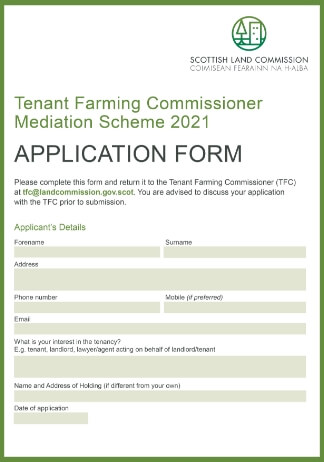
Review the scheme criteria to check you’re eligible and download the application form.

Speak with the Tenant Farming Commissioner’s team

Before applying, you can discuss your situation with the TFC. They’ll help you understand whether mediation is suitable and answer any questions about the process.

Submit your application

Complete the and send it to the TFC, either by email as a PDF, or by post. The TFC will review your application and may contact you to discuss details.

Eligibility and next steps

You’ll be informed whether your case can proceed under the scheme.

  • If accepted, you’ll be invited to choose a mediator from the TFC’s panel of mediators and make arrangements directly with them.
  • If not eligible for the scheme, you’re still welcome to contact any mediator from the panel to discuss options privately (though these would not be funded).

Agreeing costs and terms

Mediators on the TFC’s panel can claim up to £1,000 (+VAT) in funding from the Scottish Land Commission toward the cost of each approved mediation.

Parties taking part share the remaining cost equally and make payment directly to the mediator once terms are agreed.

The mediation session

The mediator will meet with both parties, together or separately, to help clarify issues and explore solutions.

If an agreement is reached, it can be written up as a record of what’s been decided.

Mediation is confidential, voluntary, and impartial. The mediator’s role is to support communication, not to take sides or make decisions.

Useful resources


TFC Mediation Scheme application form

A form to provide details about a tenancy dispute and assess eligibility for the TFC Mediation Scheme.

Panel of Mediators


Rachael Bicknell

Rachael Bicknell

Rachael Bicknell

Rachael Bicknell

Rachael Bicknell

Rachael Bicknell

Tenant Farming Helpline


If you’d like to speak to someone, we are here to help.

There are 3 main ways to get in touch:

We handle all conversations sensitively. However, as a public body, we are subject to Freedom of Information legislation. You can read more about how we handle personal information in our privacy policy.

Stay connected

Get the latest news, research and events from the Scottish Land Commission direct to your inbox